Spontaneous behavior is a succession of self-directed tasks
Neuron. 2026 Jan 28:S0896-6273(25)00894-3. doi: 10.1016/j.neuron.2025.11.021.
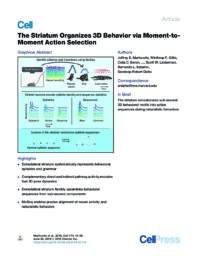
Animals achieve high-level goals by sequencing low-level actions. This transformation is best understood in structured tasks that impose a specific mapping between goals and actions. However, it remains unclear whether spontaneous behavior is similarly organized in the service of identifiable goals or how it might be supported by brain regions responsible for goal-oriented behavior, such as the prefrontal cortex (PFC). Here, we show that low-level actions in freely exploring mice are hierarchically organized into seconds-long behavioral states that correspond to task-like programs of behavior. These persistent states structure neural activity in the PFC, which preferentially encodes the identity of states relative to low-level behavioral features and shapes which states are expressed in a given context. These findings argue that spontaneous behavior is organized as a succession of self-directed tasks and identify principles of neural control that are common to structured tasks and spontaneous exploration.