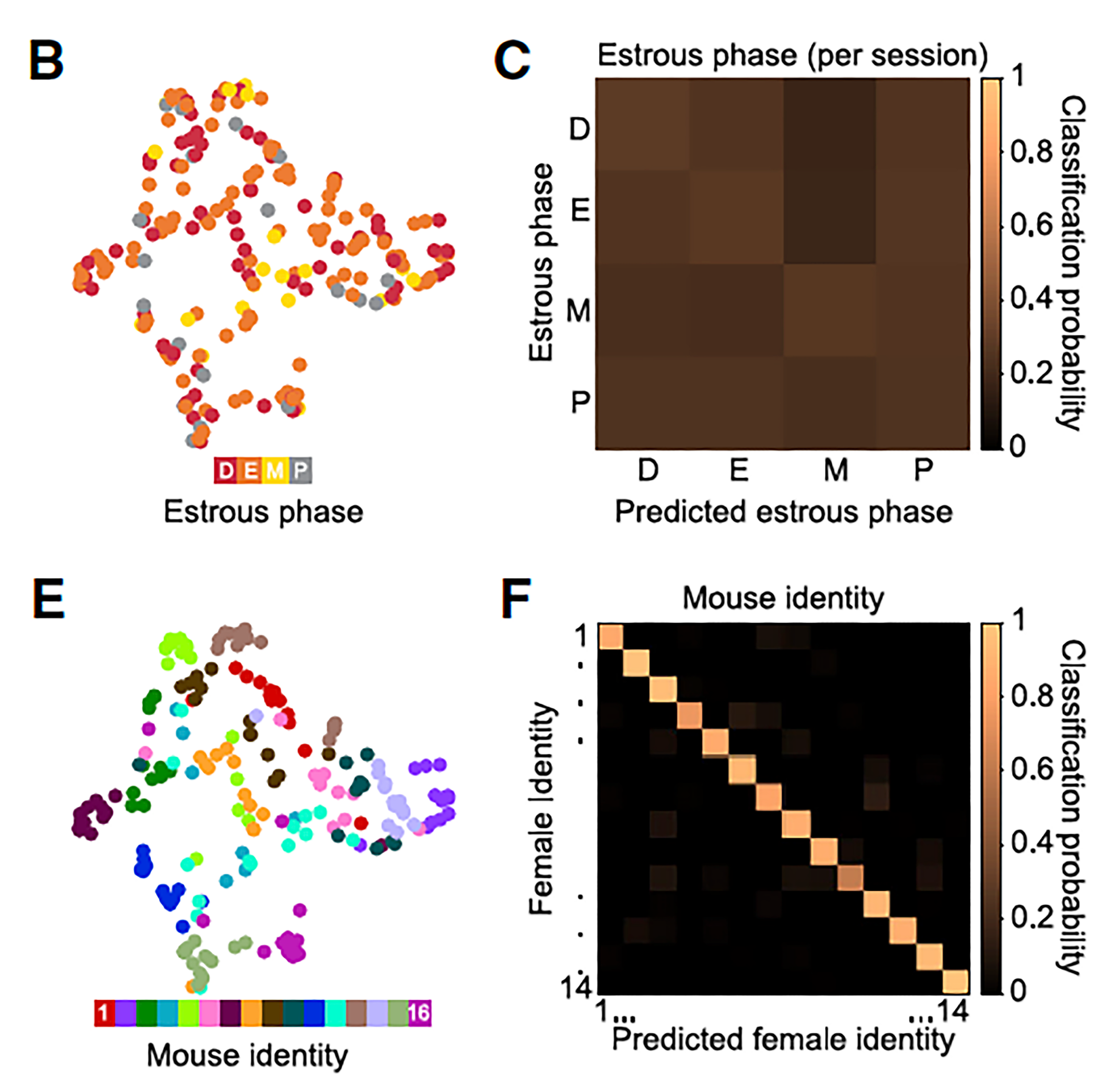
It is a *very* old commonplace: female behavior is more variable than male behavior because of hormonal variation during the estrous cycle. This pervasive belief (and the biases that come with it) has influenced the choice of rodent sex in experiments for decades, and contributed to the fact that more male mice are used to study brain function than female mice. But is it true? Dana Rubi Levy and friends address a very small slice of this big question in this recent paper, and come up with a surprising answer: at least for open field exploration, estrous seems to not matter much if at all. Instead, most of the variability in behavior observed in these experiments (in which the spontaneous behavior of mice in the open field is quantified using MoSeq) is caused by the individual identity of the mice (all of whom are 8-12 weeks old). The surprise – at least at this age, the inter-individual variability of male and female mice differs, with males actually behaving in a more variable manner (both across and within individual mice) than females. Of course, the estrous cycle is going to influence *lots* of female behaviors, especially in social contexts. But, as we show here, that is no reason to assume that female behavior is more variable in general. Check out the paper to learn more, as well as this article about the work in the NY Times!