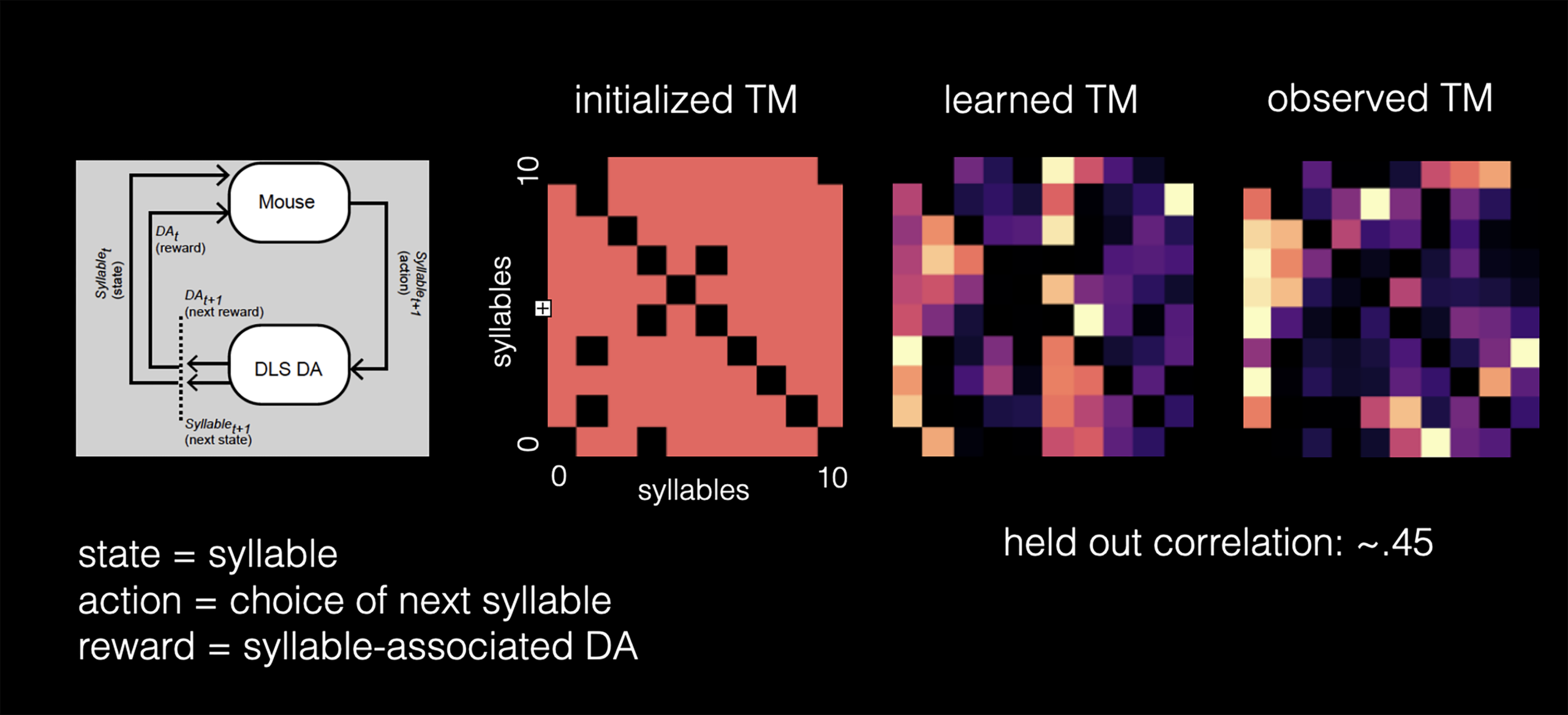
Dopamine does lots of things — it signals reward prediction errors and been linked to behavioral vigor, engagement, effort and movement itself. However ,as a general matter, people think of dopamine from the perspective of experimenter-designed tasks — you train a monkey or a mouse to do a thing, and then ask how dopamine levels change in various parts of the brain as the animal learns and performs. We wondered something different: what does dopamine do in the absence of rewards or structured tasks, like during natural behavior? To see the answer, check out our paper in Nature by the terrific trio of Jeff Markowitz, Win Gillis and Maya Jay. By combining MoSeq (done with mice running around of their own accord in the open field) with careful measurements of dopamine in the dorsolateral striatum, they found something startling: that each time the mouse switched behavioral syllables (like going from a run to a rear), there was a systematic phasic fluctuation in dopamine. Syllables are fast — in the mouse the mean duration is about 300 seconds — and DLS dopamine seems fluctuate with a matched rhythm, as if there is some important relationship between dopamine in ongoing syllables. But no matter how hard they looked, Jeff and co. could not find a relationship between the actual movements the mouse was executing and the height of the associated dopamine transient…indeed for the very same syllable, sometimes dopamine went up, and other times dopamine fell. That got them thinking that maybe syllable-associated doesn’t control movements *in the moment*, but instead acts as a natural reinforcer to encourage (or discourage) the expression of syllables in the future. Through modeling and closed loop calibrated optogenetic manipulations of dopamine triggered on targeted syllables (!), they were able to demonstrate that DLS dopamine plays a key causal role in reinforcing syllables even in the absence of explicit rewards and tasks…and indeed these fluctuations determine in a given experiment and mouse how often given syllables are used and the order in which they occur. There is a ton in this paper, but what excites us the most is the idea that the very same cells, circuits and mechanisms that influence decision-making via the cortex and basal ganglia in low-dimensional tasks are recruited to help structure the high dimensional, self-directed behavior of mice. These findings raise a ton of questions – see the paper for more!