…for our two new postdocs, Dilansu Guneykaya and Kara Fulton!
…for our two new postdocs, Dilansu Guneykaya and Kara Fulton!
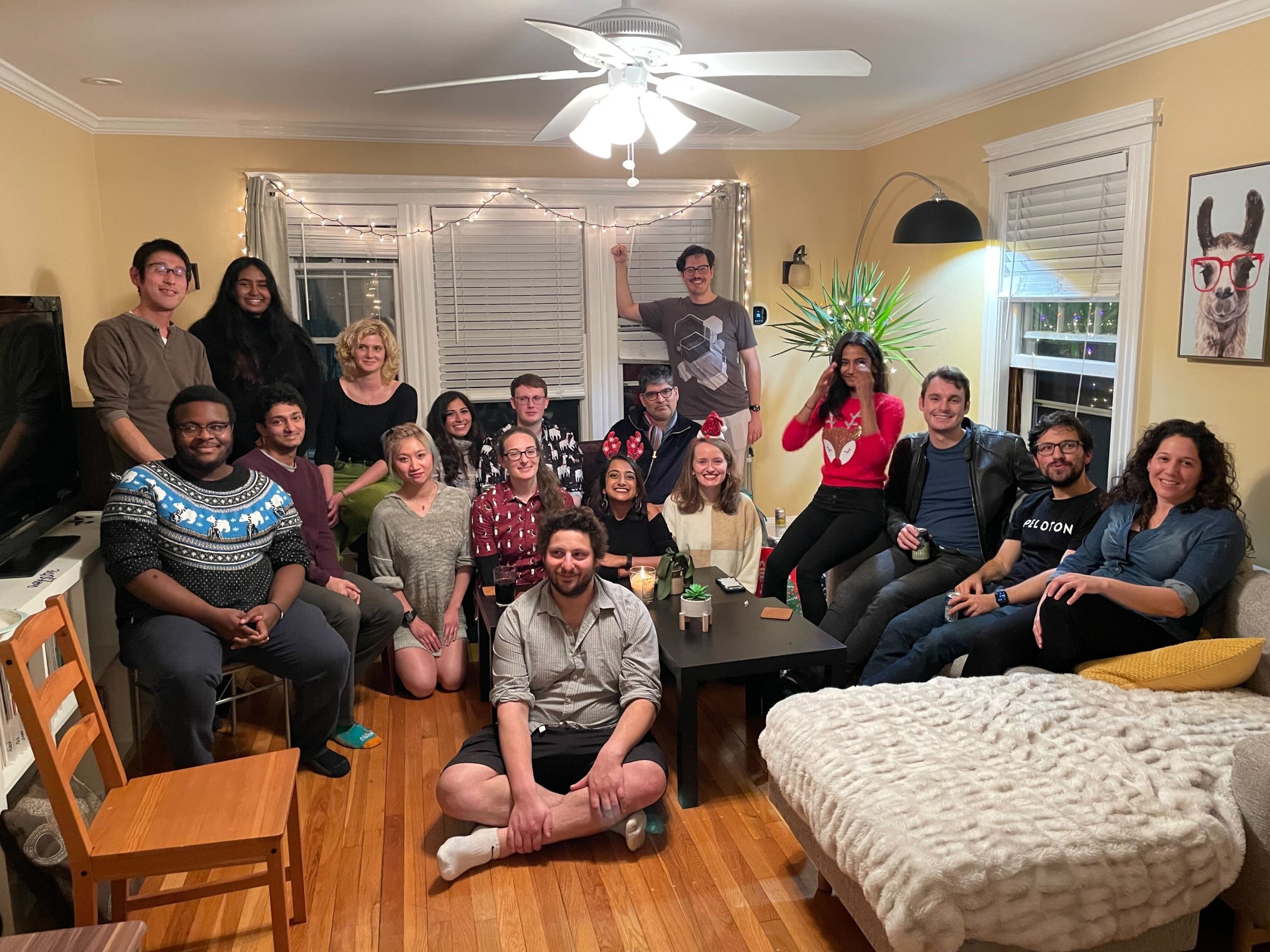
This year was messed up in so many ways, but here in the Datta lab we are counting our blessings. Very few of us have gotten COVID, for the most part things are safe enough that we can work (everyone is vaxxed and masked, of course), and despite all the challenges we got some great science done in the last year. To celebrate the season (and the ending of 2021, which really needed to end) we all got a PCR test, then an antigen test, then had our holiday party (thanks Maya for hosting!!!). We did a Yankee swap with a twist – if you were the last to steal a gift, you had to sing! Embarrassing clips below. We wish everyone the best for a wonderful and safe holiday, and look forward to doing more science and having more fun in 2022.
Check out the lab’s latest paper in Cell, led by Tatsuya and David, which demonstrates that olfactory sensory neurons (OSNs) — the cells in the nose responsible for detecting smells — use regulated gene expression to flexibly make predictions about which odors are present in the environment and to dynamically adapt their odor responses (paper here, also for those of you on twitter, see tweet thread here). We are super excited about this work, in no small part because it revises basic ideas about how the olfactory system works. It has long been thought that OSNs (each of which expresses only one of the ~1000 possible odorant receptors (ORs) encoded in the genome) faithfully send information to the brain about OR-odor interactions. The brain, in this model, therefore has access to stable information about the degree to which any given OR is activated; this fixed peripheral odor code, in principle, enables the brain not only to decode odor identity and concentration, but also to make predictions about which odors are constantly present in the background, thereby enabling the brain to emphasize new information over predictable or constant stimuli. In this view, OSNs are passive cellular vehicles whose main purpose is to express a given OR and a set of signaling molecules that couple ORs to spikes — the brain listens to these spikes, and then does all the good stuff.
In contrast to this canonical model, Tatsuya and David’s amazing work (with tons of help from Greg and Stan) reveals that the nose uses a novel transcriptional mechanism to itself make odor predictions. We’ll leave all the many surprises to the paper itself, but the work reveals that each subtype of OSN (as identified by which OR it expresses) has a unique transcriptome, that the main axis of transcriptional variation includes more that 70 genes whose function is to couple odors to spikes, that the expression of these genes systematically varies depending on the activation history of each OSN, that the environment determines OSN activation history and therefore determines OSN gene expression, and critically, that expression levels of the 70 function-related genes actually predict how strongly each OSN responds to odors — indeed gene expression is far more predictive of the extent to which an OSN will respond to an odor than the in vitro-defined binding affinity! These results demonstrate that OSNs use dynamic gene expression to predict the presence of odors in the environment, thereby filtering out the expected to emphasize the new. This work has implications for how the brain organizes information about the chemical world, for our understanding of neuronal homeostasis, and for our interpretation of the many single cell sequencing atlases being generated of various brain regions. Getting to these discoveries involved sequencing ~2 million individual cells from the nose, and inventing a whole new way to identify which ORs are activated in vivo by any odor – huge congrats to Tatsuya, David, Stan and Greg (as well as to our collaborator Tom Bozza) on their incredible work and spectacular findings!
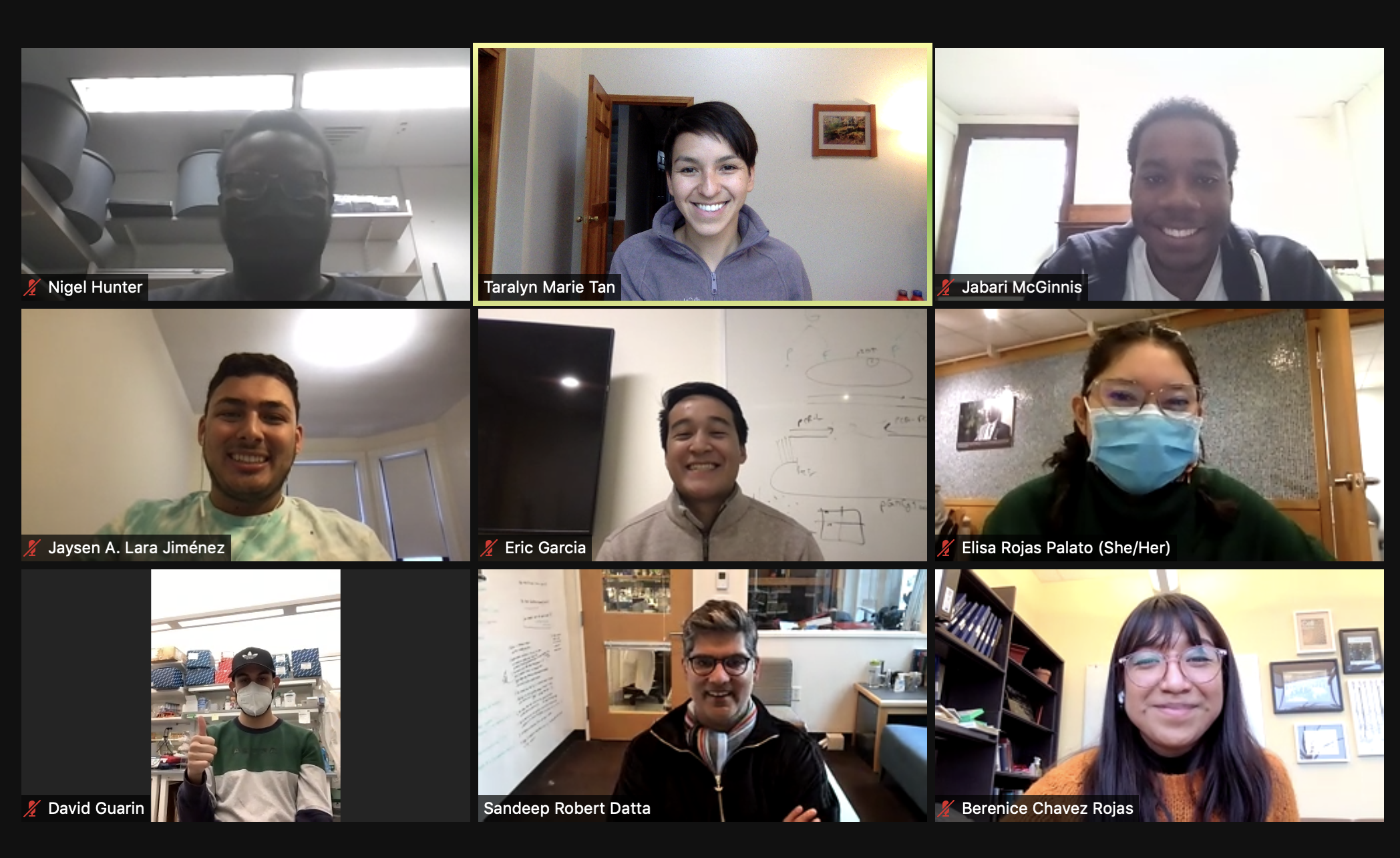
One of the great pleasures of this last year – given how messed up COVID has been – has been PiNBAC, the Program in Neuroscience postbaccalaureate program (website here). Bob and Tari Tan — PiN’s amazing director of education — started this program last year to increase diversity and to help create the next generation of leaders in neuroscience. The curriculum includes a deep research experience, a ton of career mentorship, guidance on writing graduate school applications and more. Our own Nigel Hunter is a PiNBAC student – he has been working with Dilansu and Rockwell on the role of the Ms4as in Alzheimer’s disease (and has been killing it). There are seven spectacular students in the first class, and it has been incredibly exciting to see them come together and cohere as a group. We can’t wait to see how they are going to change neuroscience in the future!