• Skip to primary navigation
  • Skip to main content
  • Skip to primary sidebar

Datta Lab

  • Research
  • The Basics
  • Academics
  • Lab Members
  • Life in the Lab
  • Publications
  • Links
  • Contact

Life in the Lab

February 4, 2026

Why is my mouse doing that?

We’ve been wondering that too! Check out this new paper from Caleb Weinreb and friends in Neuron on a new version of MoSeq called (what else?) shMoSeq, which gives you access to the behavioral states that organize mouse behavior on timescales of seconds to minutes.

OK, so what is shMoSeq, why did we build it, and what does it give us? shMoSeq is designed to address an important limitation of MoSeq, the unsupervised machine learning platform we’ve been developing to characterize behavior.  MoSeq is powerful but frustrating. On the one hand, it converts video data into information about the structure of behavior; it identifies the set of syllables (sub-second, stereotyped action motifs like rears or turns) out of which mouse behavior is organized, as well as the sequence with which they occur in any experiment. This has yielded important information about how the brain structures the microarchitecture of behavior on a moment to moment basis (see here and here). But in the end, MoSeq basically gives you a statistical description of behavioral dynamics – it tells you nothing about *why* a mouse is doing what it is doing. It also doesn’t comport with our intuition that mice often organize their behavior over timescales of seconds-to-minutes, which is the timescale at which humans typically describe behavior (and develop “ground truth” labels for supervised behavioral classifiers). Consistent with this, if we do some math (see the paper) it is clear that there are longer timescales that are organizing mouse behavior, even in a 30 minute open field experiment.
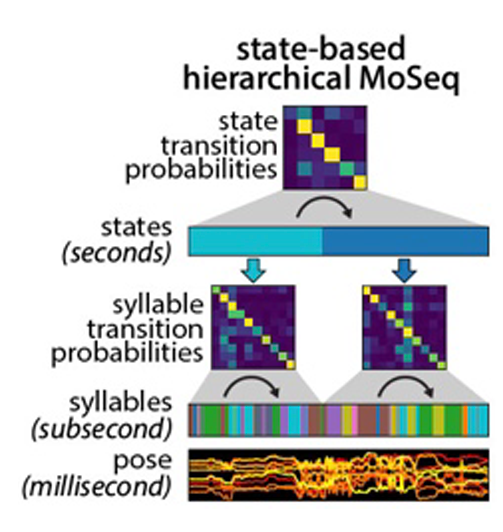
Caleb decided to tackle the longer timescale challenge by building a new, hierarchical version of MoSeq that has another layer on top of the layers corresponding to syllables (i.e., pose dynamics) and poses. This new top layer encodes behavioral states; mathematically, each state is a unique transition matrix, which describes the particular order in which syllables unfold over time.  This definition means that all syllables can be used in all states — what differs is how they are sequences into coherent patterns of behavior. Applying shMoSeq to open field behavior yields a small number of higher order states that last seconds to minutes, and which occur in series over the entire experiment; applying shMoSeq to an open field with novel objects adds a couple of extra states, as does applying it to mice engaged in social interaction.

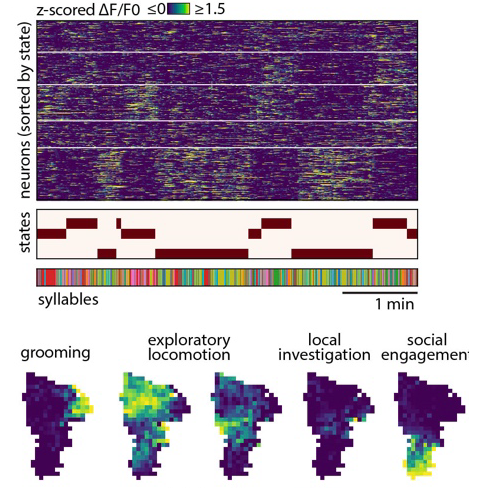
What are these states? Turns out, each corresponds to the mouse engaging with either some affordance in the arena (the walls, the floor, new objects, a social partner) in various ways, or with itself (by engaging in grooming and other care-related behaviors). In other words, it looks like during each one of these states the mouse is engaged in a self-directed task that reflects the specific affordances available in a given context. This gave Caleb the sense that maybe spontaneous behavior – as the title says – is a series of self-directed tasks. But how to prove this? Well we can’t directly (we are inferring something about the internal meaning of an external behavior after all), but Caleb generated evidence that this idea isn’t entirely unreasonable by asking the brain (in this case the pre-frontal cortex) what it seemed to care about….and it turns out during each of these states, the PFC encodes task-like variables reflecting those things that are most important for the animal to know to achieve a particular self-directed goal. For example, if a mouse is running along the arena wall, what matters most is where it is and how it is moving with respect for the wall, which turns out to be what is emphasized in the brain; if the mouse enters a different behavioral state, representations for those variables fade out and are replaced with representations for whatever variables matter in the new state.

There is all sorts of interesting and provocative stuff in this paper, but the key take-home is that with the right sorts of tools, we can now start to think about self-directed or spontaneous behavior as really being goal- or task-oriented; this aligns the study of natural behavior with long-established paradigms for studying how the brain solves problems after training. Congrats to Caleb and all the other authors!
Posted by Datta Lab

December 30, 2025

A map in the nose!

A major mystery in sensory neurobiology relates to the missing map for olfaction. All of our other senses have peripheral maps, like the map of visual space in the retina, and the frequency map in the cochlea. The existence of these peripheral maps supports the generation of e.g., the retinotopic map in V1, the tonotopic map in A1. But olfaction……not so much. In fact, for the last 30 years, since the cloning of the receptors, the main model in the field has been that each mature olfactory sensory neuron in your nose randomly chooses which of 1000 receptors to express. This randomness means there is no map.

Until now. David Brann in the lab has used a combination of single cell methods, spatial transcriptomics and a lot(!) of incredible work and thinking to reveal a structure and stereotyped map of odor receptors in the nose, and an associated molecular logic that aligns odor maps in the nose and the brain. Check it out here: https://www.biorxiv.org/content/10.1101/2025.05.02.651738v1

Posted by Datta Lab

December 29, 2025

Happy Holidays!

From all of us to all of you, we wish everyone happy holidays for 2025. May 2026 bring stability, good sense and great science for all!

Posted by Datta Lab

January 29, 2025

Interested in the lab’s work on behavior?

Then check out Bob’s recent Special Lecture at SfN on exploring the neural basis for natural behavior using computational ethology – three parts below:


http://datta.hms.harvard.edu/wp-content/uploads/2025/12/Part-1.mp4
http://datta.hms.harvard.edu/wp-content/uploads/2025/12/Part-2.mp4
http://datta.hms.harvard.edu/wp-content/uploads/2025/12/Part-3.mp4

Posted by Datta Lab

May 23, 2024

A terrific trio of graduates!

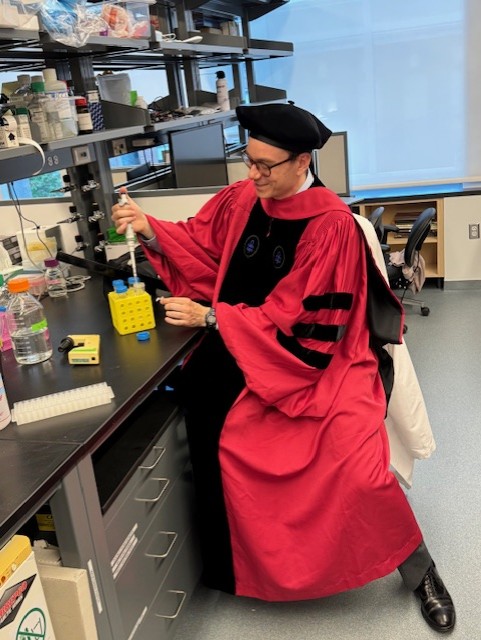
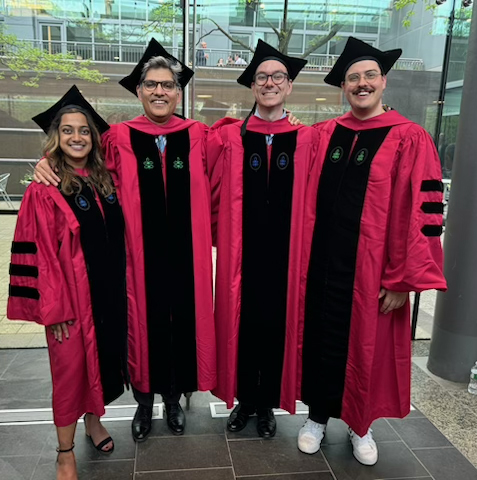
It’s always a special day when a student graduates from the lab, but in this case we have three! The amazing Maya Jay, David Brann and Win Gillis all got officially hooded today – we are all so proud of all they accomplished (you can read some of their work here, here, here, and here), with much more exciting work from these three on dopamine, behavior, aging and the molecular organization of olfaction to come in the near future. Win and David are both sticking around for a bit to finish up some exciting science, while Maya has already started an amazing new career starting companies in the life sciences space. They have all given so much to the lab, and it has been such a privilege to work with them – all of us in the Datta lab wish them all the best!

Congrats to the new grads!
David showing us how it is actually done 🙂

Posted by Datta Lab

June 21, 2022

A fond goodbye to Professor Markowitz

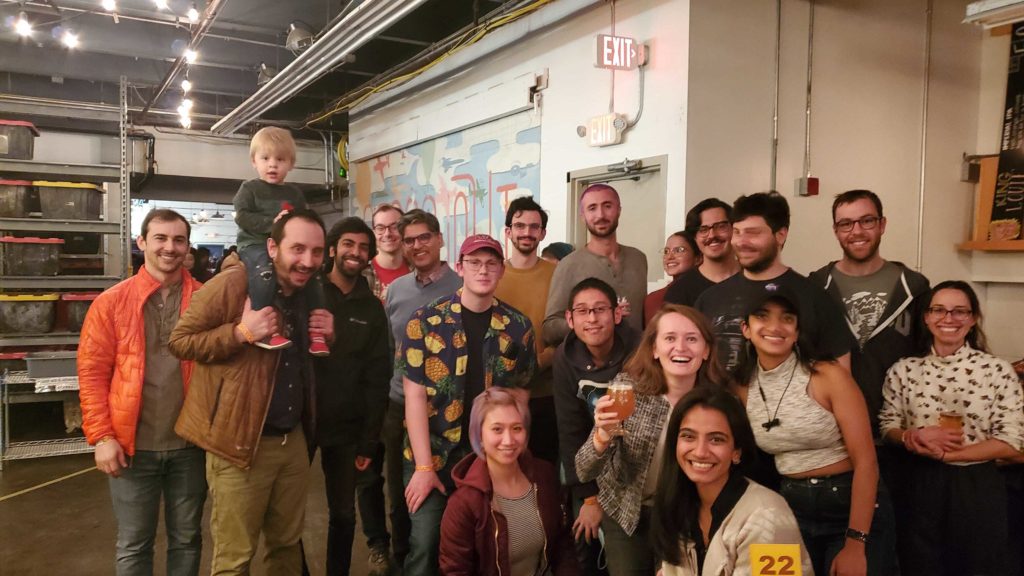
We are still writing a paper together (stay tuned!) so it feels like he hasn’t really left, but our beloved postdoc Jeff Markowitz recently decamped to start his own laboratory at Georgia Tech (https://bme.gatech.edu/bme/faculty/Jeffrey-Markowitz). We won’t even try to summarize all his many contributions to the lab and all of the great science he did (although see https://pubmed.ncbi.nlm.nih.gov/29779950/), but he is a amazing both as a scientist and a person, and he will be sorely missed. Anyone interested in a terrific mentor at Georgia Tech/Emory should check out his new lab, which will work on building better brain-machine interfaces. Pic of goodbye party below…as well as a special message from the most powerful individual in the universe.

http://datta.hms.harvard.edu/wp-content/uploads/2022/06/Cameo-by-John-de-Lancie-via-cameo.mp4

Posted by Datta Lab

January 20, 2022

COVID Cartoon :)

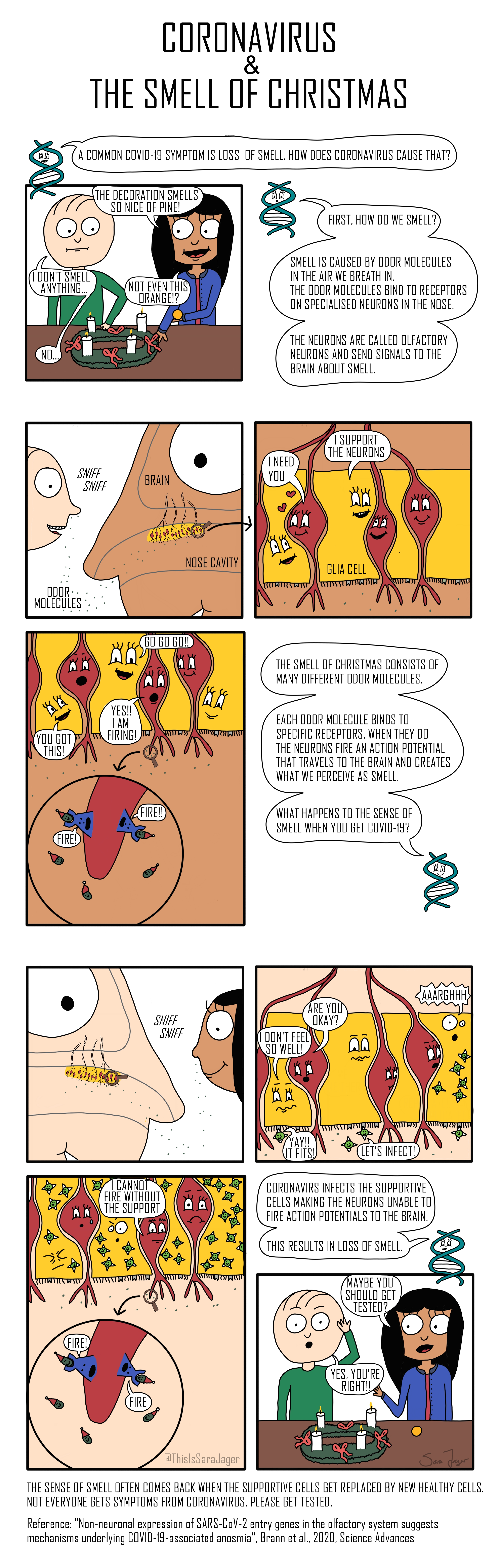
Sara Jager (https://www.saraejager.com/) is a postdoc at King’s College, and in her spare time makes science cartoons. She liked the Brann COVID paper, and so did one about smell and the pandemic – check it out!


Posted by Datta Lab

December 30, 2021

A late welcome to the lab….

…for our two new postdocs, Dilansu Guneykaya and Kara Fulton!

Posted by Datta Lab

December 26, 2021

Happy Holidays 2021!

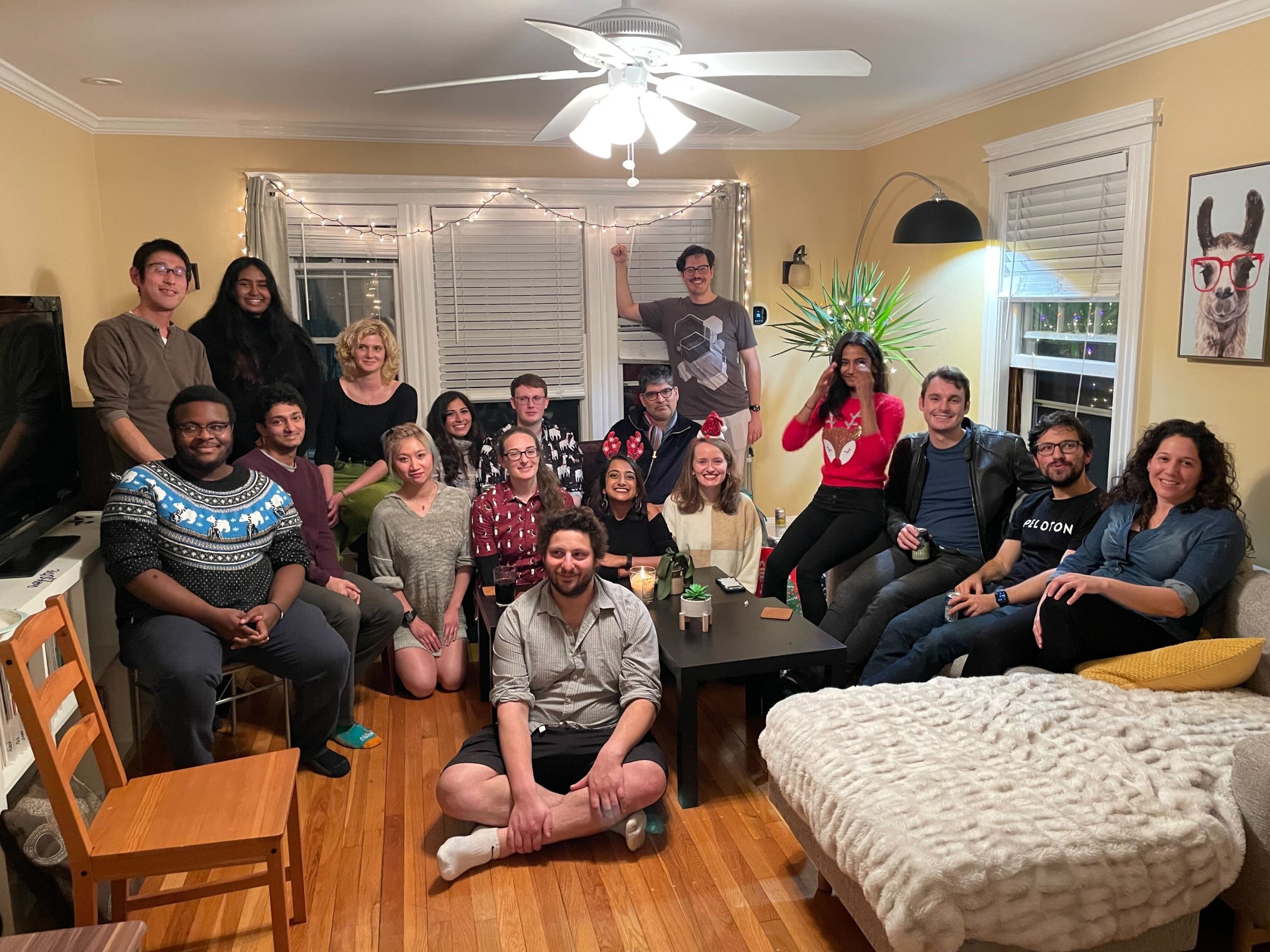
most people are smiling 🙂

This year was messed up in so many ways, but here in the Datta lab we are counting our blessings. Very few of us have gotten COVID, for the most part things are safe enough that we can work (everyone is vaxxed and masked, of course), and despite all the challenges we got some great science done in the last year. To celebrate the season (and the ending of 2021, which really needed to end) we all got a PCR test, then an antigen test, then had our holiday party (thanks Maya for hosting!!!). We did a Yankee swap with a twist – if you were the last to steal a gift, you had to sing! Embarrassing clips below. We wish everyone the best for a wonderful and safe holiday, and look forward to doing more science and having more fun in 2022.

http://datta.hms.harvard.edu/wp-content/uploads/2021/12/JEff.mp4
http://datta.hms.harvard.edu/wp-content/uploads/2021/12/win.mp4
http://datta.hms.harvard.edu/wp-content/uploads/2021/12/Mariah.mp4


Posted by Datta Lab

December 25, 2021

Predictions in the olfactory system – new paper by Tatsuya and David!

Check out the lab’s latest paper in Cell, led by Tatsuya and David, which demonstrates that olfactory sensory neurons (OSNs) — the cells in the nose responsible for detecting smells — use regulated gene expression to flexibly make predictions about which odors are present in the environment and to dynamically adapt their odor responses (paper here, also for those of you on twitter, see tweet thread here). We are super excited about this work, in no small part because it revises basic ideas about how the olfactory system works. It has long been thought that OSNs (each of which expresses only one of the ~1000 possible odorant receptors (ORs) encoded in the genome) faithfully send information to the brain about OR-odor interactions. The brain, in this model, therefore has access to stable information about the degree to which any given OR is activated; this fixed peripheral odor code, in principle, enables the brain not only to decode odor identity and concentration, but also to make predictions about which odors are constantly present in the background, thereby enabling the brain to emphasize new information over predictable or constant stimuli. In this view, OSNs are passive cellular vehicles whose main purpose is to express a given OR and a set of signaling molecules that couple ORs to spikes — the brain listens to these spikes, and then does all the good stuff.

In contrast to this canonical model, Tatsuya and David’s amazing work (with tons of help from Greg and Stan) reveals that the nose uses a novel transcriptional mechanism to itself make odor predictions.  We’ll leave all the many surprises to the paper itself, but the work reveals that each subtype of OSN (as identified by which OR it expresses) has a unique transcriptome, that the main axis of transcriptional variation includes more that 70 genes whose function is to couple odors to spikes, that the expression of these genes systematically varies depending on the activation history of each OSN, that the environment determines OSN activation history and therefore determines OSN gene expression,  and critically, that expression levels of the 70 function-related genes actually predict how strongly each OSN responds to odors — indeed gene expression is far more predictive of the extent to which an OSN will respond to an odor than the in vitro-defined binding affinity! These results demonstrate that OSNs use dynamic gene expression to predict the presence of odors in the environment, thereby filtering out the expected to emphasize the new. This work has implications for how the brain organizes information about the chemical world, for our understanding of neuronal homeostasis, and for our interpretation of the many single cell sequencing atlases being generated of various brain regions. Getting to these discoveries involved sequencing ~2 million individual cells from the nose, and inventing a whole new way to identify which ORs are activated in vivo by any odor – huge congrats to Tatsuya, David, Stan and Greg (as well as to our collaborator Tom Bozza) on their incredible work and spectacular findings!

Posted by Datta Lab

Older Posts »

Primary Sidebar

Blog Archive

  • February 2026
  • December 2025
  • January 2025
  • May 2024
  • June 2022
  • January 2022
  • December 2021
  • December 2020
  • November 2020
  • October 2020
  • August 2020
  • May 2020
  • April 2020
  • March 2020
  • January 2020
  • December 2019
  • November 2019
  • August 2019
  • June 2019
  • October 2018
  • July 2017
  • June 2017
  • May 2017
  • April 2017
  • February 2017
  • December 2016
  • November 2016
  • October 2016
  • July 2016
  • June 2016
  • April 2016
  • March 2016
  • December 2015
  • October 2015
  • September 2015
  • May 2015
  • October 2014
  • January 2014
  • January 2013
  • October 2012
  • June 2012
  • May 2012
  • February 2012
  • December 2011
  • October 2011
  • August 2011
  • July 2011
  • April 2011
  • March 2011
  • February 2011
  • January 2011
  • November 2010
  • October 2010
  • September 2010
  • July 2010

HISTORY SHOWS AGAIN AND AGAIN HOW NATURE POINTS OUT THE FOLLY OF MEN – “GODZILLA,” BLUE OYSTER CULT

Sandeep Robert Datta, MD, Ph.D Department of Neurobiology Harvard Medical School